
Using AI to save your business, a guide
But first the reasons why

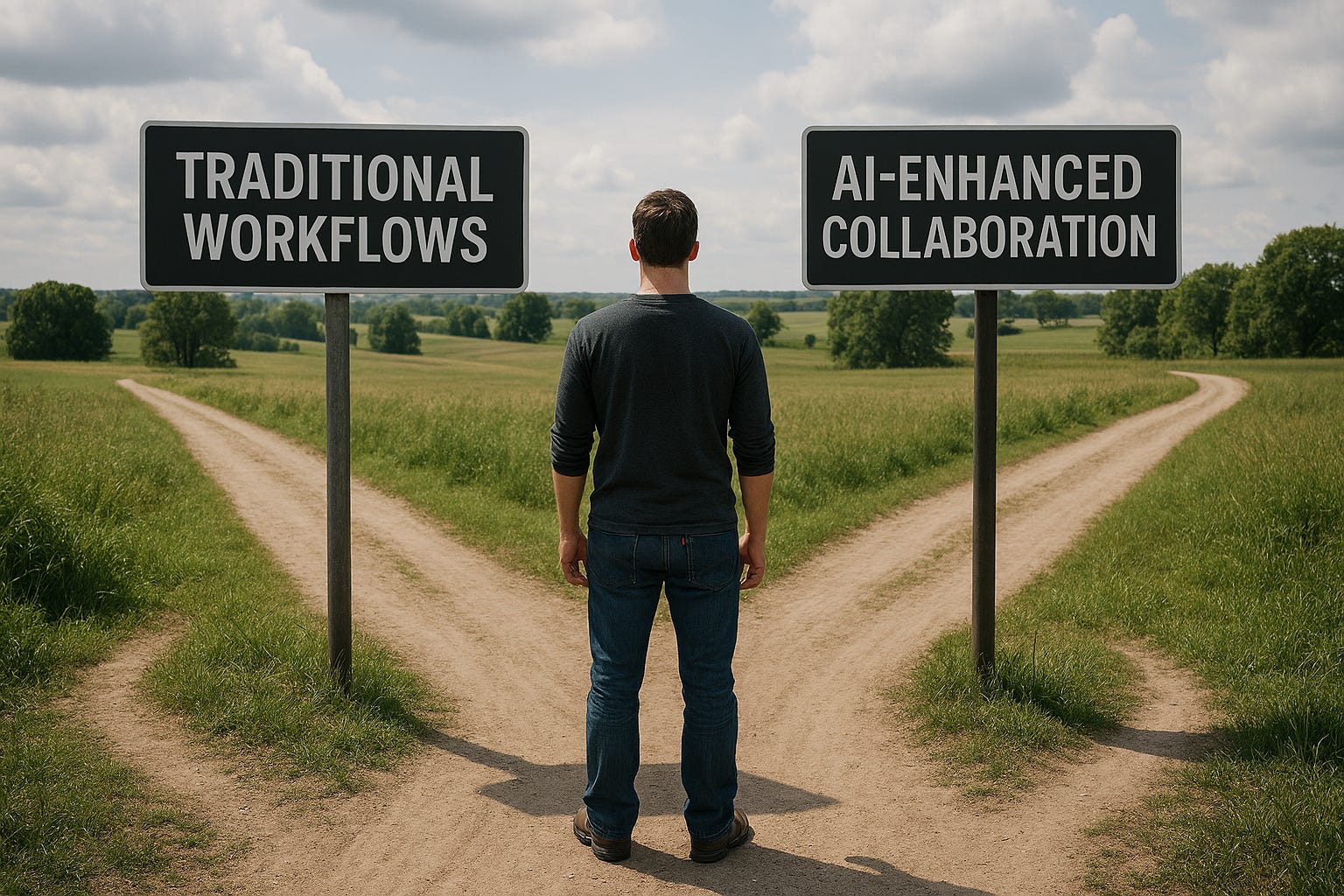
Most of us have spent years learning to navigate software, we click through menus, fill out forms, follow prescribed workflows. we have become fluent in the language of user interfaces, conditioned to break every task into a series of manual steps. That fluency is about to become obsolete. AI is not simply another tool to add to your stack, it represents a fundamental reordering of how work gets done. Three specific changes are already underway, and understanding them is not optional for anyone who leads a team, runs a business, or wants to remain relevant in their field.
In late 2022 I made a statement to a SaaS vendor “The UI as we know it is dead”, I was laughed at, guess what, they’re all moving as quickly as possible to have an AI front door.
There is a prompt at the end of this for you to try out, but do yourself a favour and get the context by reading this first.
We are approaching a threshold where opening an AI interface will replace opening a browser - the new AI browsers feel like a transitionary step. This is already visible in early integrations, ChatGPT now connects directly to Expedia and Booking.com, enabling you to plan a holiday without every engaging those sites at all. This pattern is going to expand rapidly.
The implication of this is catastrophic for companies that are slow to react. Companies that depend on you visiting their website or opening their app to generate revenue are facing a very real existential threat. AI will not be a feature bolted onto existing systems, it is rapidly becoming the primary environment where tasks begin and often end. Discovery, decision making, and execution will move upstream into the AI layer, functionality that once required a separate interface will become native to the AI itself.
This is a distribution change not just a technology change, if your business model relies on people coming to you, that assumption is under pressure. The interfaces that add friction will lose, the capabilities that resolve intent will win.
Every piece of software you use today is a front end for a database. Scheduling a meeting, sending a file, running a report - all of these actions involve retrieving or manipulating data stored somewhere. We have accepted that interacting with that data requires following rigid, declarative workflows, click here, then here, then fill this out, then submit.
AI introduces something fundamentally different, it becomes a middle layer that sits between you and the database. This layer interprets intent rather than requiring explicit instructions. You stop telling the system what to do and start telling it what you want, the AI constructs its own plan to achieve the outcome. But isn’t that what a UI is? Yes, and the UI is dead as we know it, SaaS platforms just don’t want to admit it.
This is not speculative, Claude can already build user interfaces dynamically from a text prompt, agentic systems can autonomously create deliverables. The shift from declarative to intent driven interaction is happening now, and it will become pervasive.
The consequence is that much of what we think of as “using software” will disappear. The hours spent navigating menus, copying data between systems, and manually orchestrating workflows will be compressed or eliminated. Work will feel less like operating machinery and more like articulating goals. This is the shift that provokes the most anxiety, the workers who will thrive in an AI driven environment are those who encode their own expertise into AI systems. They will build tests, create checklists, provide examples, and teach the AI to replicate their judgment in routine scenarios.
The instinct is to resist this, why would anyone train a system to do their job? The fear of redundancy is real, but the logic is backwards. AI is not good at novelty. It is not good at navigating ambiguity or making judgment calls in unprecedented situations, it is however exceptionally good at pattern recognition and repetition.
The opportunity is to offload the repetitive, the predictable, the tedious, the hours spent on routine analysis, standard documentation, or repetitive coding can be handed to the AI. This frees humans to focus on the exceptions, the strategy, the big picture thinking. The workers who encode their expertise are not making themselves obsolete, they are making themselves more valuable by ensuring their time is spent on work that actually requires human judgment.
This also creates a new form of institutional knowledge, organisations that document how their best people think, and teach AI systems to replicate that thinking, will build a durable advantage. This is not about replacing people, it’s about scaling judgment, scaling creativity and making better human lead AI augmented decisions.
These three shifts are not distant possibilities, they are already reshaping competitive dynamics, you are at risk if your business creates interface friction by forcing people through non-AI funnels, you are at risk if your processes are brittle and cannot adapt, you are at risk if your knowledge is trapped in static documents or in the heads of a few key people.
The organisations that will survive this transition are those that recognise AI as a platform, not a feature. They will redesign workflows to be intent-driven rather than declarative. They will invest in encoding expertise rather than hoarding it.
First, hold two realities at once, your business still runs on existing systems, you cannot abandon them overnight. But you also cannot pretend that those systems will remain relevant indefinitely, the strategic task is to maintain today’s infrastructure while simultaneously investing in tomorrow’s. This is uncomfortable! It requires operating with a dual mindset, funding initiatives that may not pay off for years, and accepting that some of what you are maintaining today will eventually be retired.
Second, take personal responsibility for your AI literac0, this is not something you can delegate to your technology team. The cost of ignorance is high, leaders who do not understand what AI can do will set vague strategies, miss opportunities, and fail to recognise threats until it is too late. Spend thirty minutes a week experimenting. Attend events. Hire consultants. Publish what you learn. Make it a visible priority.
Third, orient toward long term transformation rather than short term return on investment. You will see some immediate wins, faster drafting, better data analysis, more efficient customer communication. But the real goal is not to shave a few hours off existing processes. The real goal is to survive and thrive in an environment where AI is the default platform for work. That transformation will not produce feel good metrics in the first year, it will require patience, investment, and a willingness to tolerate ambiguity.
Fourth, stop waiting for certainty, there is no business that will remain untouched by this technology. Existing strategic frameworks still apply. Porter’s Five Forces, competitive positioning, value chain analysis, all of these tools work just as well for AI as they did for previous waves of disruption. Figure out how you will be disrupted. Make a plan. Start now.
If you are unsure where to begin, use this prompt with any AI system, use a deep thinking mode:
“I lead a [COMPANY SIZE] [INDUSTRY] company. Assume AI will eliminate the need for most of what we currently sell or do within 3 years. Challenge me:
Which of our current revenue streams exist only because of interface friction, information asymmetry, or manual process inefficiency that AI will collapse?
What would a competitor with no legacy infrastructure, no existing customer contracts, and native AI capabilities do that we cannot? Why can’t we do it?
If customers could accomplish their goal without ever touching our product or visiting our website, what would we need to become? What capability would be valuable enough that an AI would call us rather than replace us?
What expertise exists only in our people’s heads that we’re not capturing? What decisions do we make repeatedly that we haven’t encoded? What’s stopping us?
Show me three specific workflows where we force customers or employees through 5+ steps that could become a single intent. Why are we still doing it the old way?
What would we need to stop doing, stop measuring, or stop selling to actually transform rather than just optimize? What sacred cows are we protecting?
What does ‘good’ look like if we can’t measure it with traditional ROI for 18 months? How will we know we’re making progress on transformation rather than just adding AI features to a dying model?
Be specific. Be brutal. Assume I’m wrong about what matters.”
This will not give you a perfect strategy. It will give you a starting point. Refine it, test it, share it with your team. The act of articulating a strategy forces clarity. The act of testing it forces learning. Both are necessary.
The shifts are already underway. The question is not whether they will happen. The question is whether you will lead through them or be led by them.